
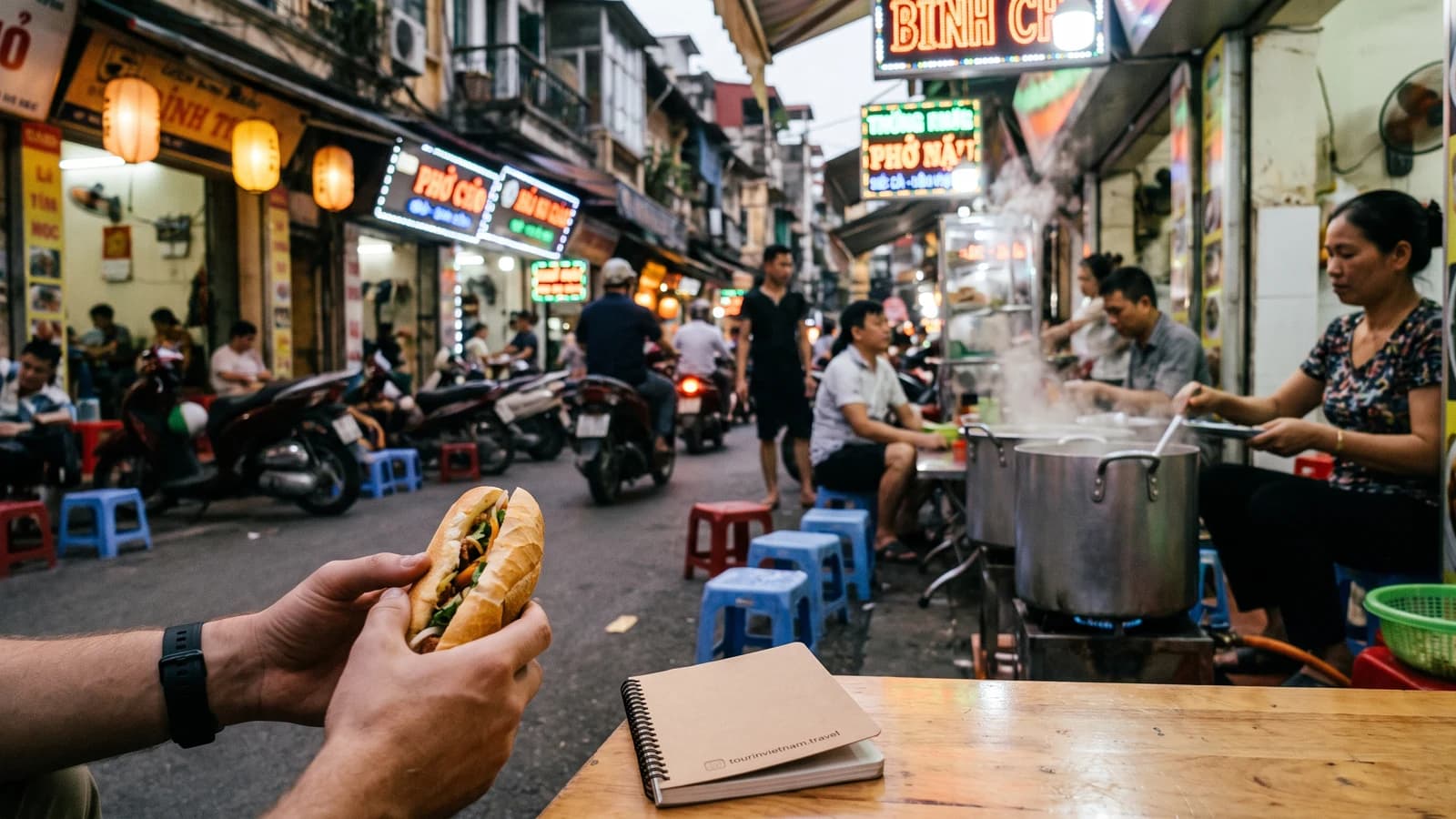
Vietnamese Street Food: A First-Timer's Survival Guide
The best food in Vietnam is on the sidewalk — tiny plastic stools, steaming bowls, and no English menu. A guide to what to eat, how to order, and how to avoid getting sick.
Why Street Food
Vietnamese street food is the best and cheapest food in Southeast Asia, period. A bowl of pho costs $2. A banh mi is $1. A feast of six dishes at a Binh Dan (home cooking) restaurant costs $5. The quality is high because the vendors serve the same customers every day — bad food puts them out of business in a week.
The Essential Dishes
Pho ($1.50-3)
Beef noodle soup — the national dish. **Hanoi style** (Bac) has flat noodles, clear broth, thin-sliced beef, green onion. **Saigon style** (Nam) has sweeter broth, more herbs, bean sprouts, and hoisin-sriracha on the side. Eat it for breakfast.
**Order:** "Pho bo" (beef), "Pho ga" (chicken). Tweak with chili, lime, bean sprouts.
Banh Mi ($0.50-1.50)
The Vietnamese baguette sandwich — French colonial bread, Vietnamese fillings. A proper banh mi has pork roll (cha lua), cold cuts, pate, mayonnaise, pickled daikon and carrot, cucumber, cilantro, chili. **Banh Mi Huynh Hoa** in HCMC is the most famous. But honestly, any banh mi stall with a line is good.
Bun Cha ($1.50-2.50)
Grilled pork patties in a warm, sweet-sour fish sauce broth, with thin vermicelli noodles and fresh herbs. **Hanoi's dish.** The Obama bun cha is famous but not the best. Follow the lunchtime crowd of office workers.
Com Tam ($1.50-3)
Broken rice — the Southern lunch staple. Served with grilled pork chop (suon nuong), shredded pork skin (bi), steamed egg meatloaf (cha trung), and fish sauce. The combination plate is the move.
Goi Cuon ($0.50/roll)
Fresh spring rolls — shrimp, pork, vermicelli, herbs, wrapped in rice paper, dipped in hoisin-peanut sauce. Light, healthy, addictive. The fried version (Cha Gio / Nem Ran) is equally essential.
Cao Lau ($2-3)
**Hoi An's dish** — thick noodles, sliced pork, croutons, herbs, and a rich broth made with water from the ancient Ba Le well. It only tastes right in Hoi An because the well water is the ingredient.
How to Eat Like a Local
1. **Small plastic stool** — the lower the stool, the better the food 2. **Use chopsticks and the spoon** (the big Chinese-style spoon, not a Western soup spoon) 3. **Add the herbs and chilies yourself** — they're on every table 4. **Drink the broth after you finish the noodles** — the final slurp is the point 5. **Pay when you leave** — tell them what you ate and they trust you
The Safety Part
Most travelers get some form of stomach trouble in Vietnam. It's rarely the food — it's the water. **Rules:** - No tap water (even for brushing teeth in Hanoi) - No ice from street vendors selling drinks in bags (hotels and restaurants use filtered ice — ask) - No peeled fruit from unrefrigerated stalls - Wash hands before eating (carry sanitizer) - **Eat where the locals eat** — a busy stall at lunch is safe. An empty stall is a red flag.
The Golden Rule
If you see a woman over 50 with a bamboo pole and two steaming baskets, sit down. She's been making that dish for 30 years, and her customers are the people who grew up on it. The food is safe, it's authentic, and it costs less than a coffee at Starbucks. That's Vietnam.
Ready to explore Vietnam?
Browse tours and activities, or tell us what you're looking for and we'll suggest the best options.
Stay Connected in Vietnam
Airalo eSIMs work on arrival — no physical SIM needed. Data plans from $5 for 7 days.
Travel Insurance for Vietnam
Medical, trip cancellation, and adventure sports covered. Plans from $1.5/day.